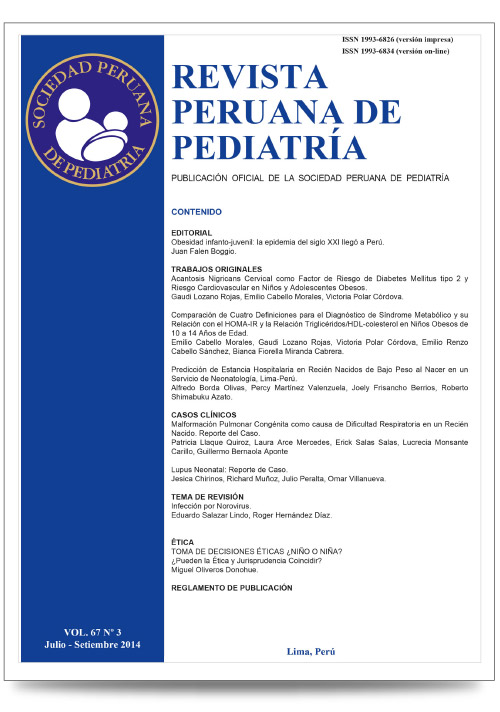
Cervical Acanthosis Nigricans as a Predictor of Risk of Type 2 Diabetes Mellitus and Cardiovascular Risk in Obese Children and Adolescents
Trabajo Ganador del Primer Lugar en el XXVIII Congreso Peruano de Pediatría. Ica, Perú.
DOI:
https://doi.org/10.61651/rped.2014v67n3p131-138Keywords:
Acanthosis Nigricans, Insulin Resistance, Heart Disease Risk Factors, Pediatric ObesityAbstract
Introduction: There is increasing prevalence of type 2 diabetes mellitus (T2DM) in obese children and adolescents. The pathophysiological mechanism is insulin resistance (IR), determined by the index of insulin resistance (HOMA-IR), biochemical predictor of T2DM. There association between acanthosis nigricans (AN) and HOMA-IR but it is unknown the association with triglycerides / HDL-cholesterol ratio (TG/HDL-C), a predictor of cardiovascular risk (CVR).
Objective: To estimate the prevalence of IR and the association between cervical AN, HOMA-IR and TG/HDL-C in obese children and adolescents. Methods: We included 77 obese patients with AN and without AN 55, matched by sex, age and BMI Z-score. We evaluate anthropometry, glucose, insulin, triglycerides, HDL-C, HOMA-IR, TG / HDL-C. We use as reference the HOMA-IR> 3.1 and the TG / HDL-C≥2.32. We performed bivariate and multivariate statistics.
Results: The prevalence of IR was 50.9% (95% CI 37.1-64.6) in obese without AN and 72.7% (95% CI 61.4-82.3) in obese patients with AN, with a significant difference (p = 0.01). Adjusted for age, sex and BMI Z-score: association between IR and AN (1.1-5.2, p = 0.02 OR=2.4, 95% CI) was found. We found no association between AN, glucose, cholesterol, triglycerides, HDL-C and TG/HDL-C.
Conclusions: IR high prevalence in both groups was found, therefore high risk of developing DM2. Association between AN and HOMA-IR was found, so we recommend using the AN as a clinical predictor of IR and T2D risk and HOMA-IR as a biochemical predictor of IR in patients without AN, to intensify prevention measures DM2. No association between AN and TG/HDL-C ratio as a marker of cardiovascular risk was found.
Downloads
Downloads
Published
How to Cite
Issue
Section
Categories
License

This work is licensed under a Creative Commons Attribution 4.0 International License.
Authors will retain the copyright and grant the right to publish their work in the journal while allowing third parties to share it under the Creative Commons Attribution license.
Articles are published under a Creative Commons license that allows sharing and adaptation with appropriate credit. CC BY 4.0 license. Available in English at https://creativecommons.org/licenses/by/4.0/
Authors may use other information disclosure formats as long as the initial publication in the journal is cited. The dissemination of the work through the Internet is recommended to increase citations and promote academic exchanges.
The published content does not necessarily reflect the specific point of view of the journal, and the authors assume full responsibility for the content of their article.