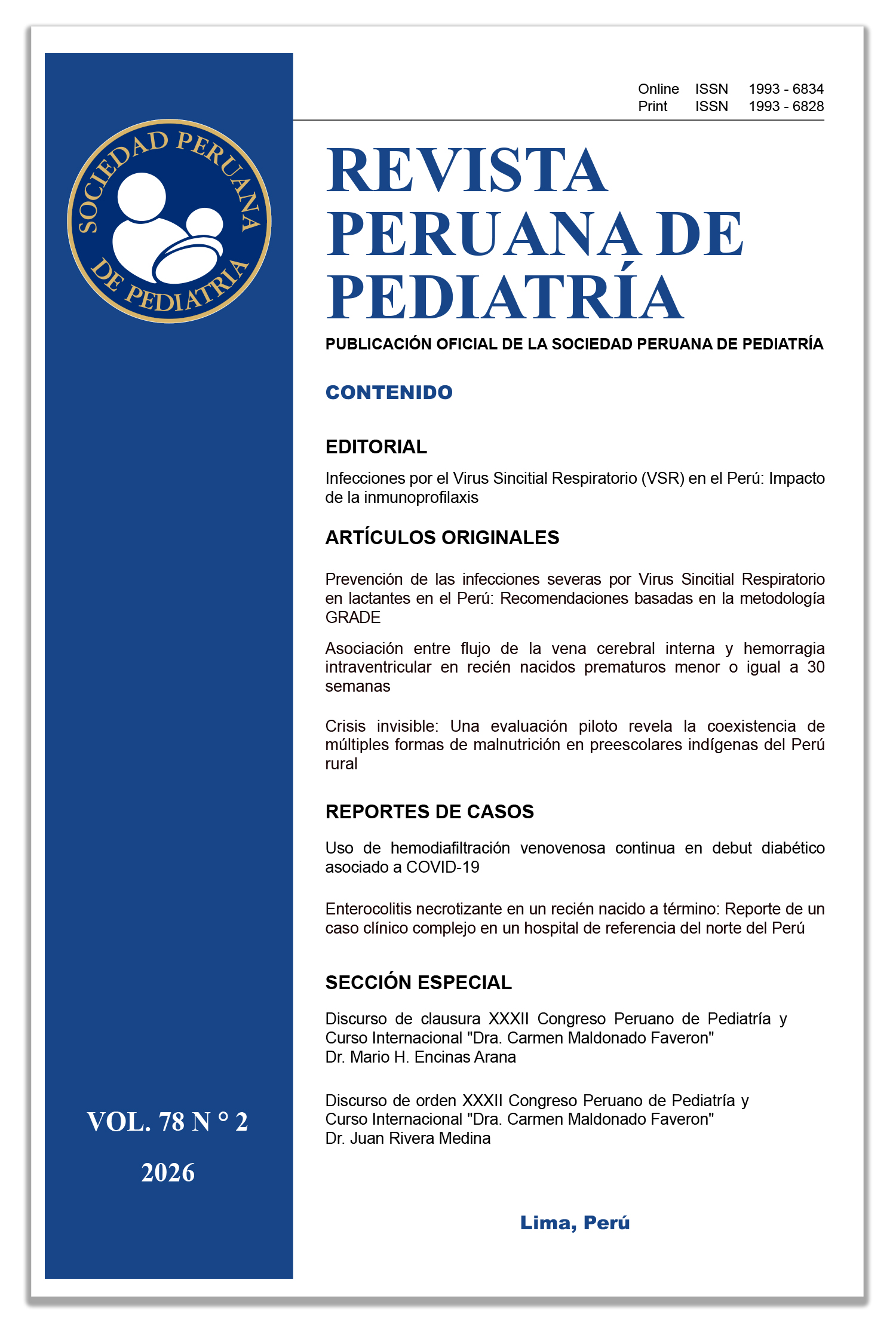
ASSOCIATION BETWEEN INTERNAL CEREBRAL VEIN BLOOD FLOW AND INTRAVENTRICULAR HEMORRHAGE IN PRETERM INFANTS BORN AT 30 WEEKS' GESTATION OR LESS
DOI:
https://doi.org/10.61651/rped.2026v78n2p16-23Keywords:
Intraventricular hemorrhage, premature newborn, doppler ultrasound internal, cerebral veinAbstract
Objective: To determine the association between internal cerebral vein flow and the presence of interventricular hemorrhage in premature newborns less than or equal to 30 weeks. Methods: An applied, observational, longitudinal, comparative, prospective study was conducted. The sample consisted of 33 neonates. All participants underwent Doppler ultrasound studies of the internal cerebral vein during the first days of life, evaluating flow characteristics such as maximum velocity, minimum velocity, the ratio between the two, and the pattern. Statistical analysis included the mann-whitney U test and Fisher's exact test. Results: The incidence of intraventricular hemorrhage was 24.2%. Newborns with intraventricular hemorrhage had significantly higher peak flow velocities compared to those without hemorrhage on days 1 (p=0.04), 2 (p<0.001), 3 (p<0.001), 4 (p=0.002), and 7 (p=0.049) of monitoring. They also showed lower minimum-to-peak velocity ratios on days 1 (p<0.001), 2 (p<0.001), 3 (p<0.001), and 7 (p=0.025), and a higher frequency of irregular waves on days 1 (p=0.003), 2 (p=0.030), and 7 (p=0.046). Conclusion: Altered internal cerebral vein flow was significantly associated with the presence of intraventricular hemorrhage in premature newborns less than or equal to 30 weeks.
Downloads
Downloads
Published
How to Cite
License
Copyright (c) 2026 Eduardo Alarcón Abasalo, Michael Eliot Cruz Reategui Cruz Reategui, Víctor Garay Gutiérrez

This work is licensed under a Creative Commons Attribution 4.0 International License.
Authors will retain the copyright and grant the right to publish their work in the journal while allowing third parties to share it under the Creative Commons Attribution license.
Articles are published under a Creative Commons license that allows sharing and adaptation with appropriate credit. CC BY 4.0 license. Available in English at https://creativecommons.org/licenses/by/4.0/
Authors may use other information disclosure formats as long as the initial publication in the journal is cited. The dissemination of the work through the Internet is recommended to increase citations and promote academic exchanges.
The published content does not necessarily reflect the specific point of view of the journal, and the authors assume full responsibility for the content of their article.